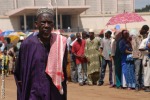
Tuesday, October 30, 2012

One Week before Micah turns 13 . . .

Go down two flights of stairs on the Africa Mercy and you’ll find you’ve stepped out of a ship and into a busy buzzing hospital. On the wards you’ll find kids playing, patients visiting, and plenty of African music. Listen and you’ll hear conversations in English echoed by translators in French or one of Guinea’s three local languages – the chatter abounds like white noise.
 One would expect that a 13-year-old girl would be among the chattiest, but not Memouna.
Memouna’s pronounced facial tumor began above her left eyebrow, spilling down her face to the corner her mouth, displacing her left eye. This tumor, a neurofibroma Memouna has had since birth, left her looking like one side of her face was sliding off, like Dali’s famous melting clock in a desert. From behind the curtain of her deformity, Memouna saw the world with her good right eye. And to her despair, the world saw Memouna.


For 13 years she was taunted for her appearance. Moreover, superstitions run deep in West African culture and physical deformities are believed to be the sinister mark of someone cursed. Memouna was not only teased by peers; she was dismissed as something less than human. From the drooping facial tumor came the source of a broken spirit.
“She was not happy because in Africa people stay away from her. She would cry because she did not understand why no one liked her,” said Memouna’s 17-year-old sister Aminata, the oldest of her nine siblings.
On Wednesday September 26, 2012, Mercy Ships surgeons removed Memouna’s tumor. After her operation, even under layers of bandages, the transformation was profound. Memouna’s profile no longer appeared rough and misshapen; her face had been physically lifted from the weight of the tumor. Nurses hoped her spirits would follow, but countering years of social isolation is a much more invasive procedure.
 In the days after her surgery, quiet Memouna said nothing while her father and sister took turns staying at the hospital and speaking on her behalf. “I’m sorry, maybe she will talk another day,” her sister would say.

“It was a long time before I realized she spoke. She was so silent that I didn’t think she could,” said Lynne White, a Mercy Ships ward nurse. “But I can understand it, she went from spending her life keeping to herself with no friends and then she came here and was overwhelmed by the attention.”
- – -
On a night about a week after her surgery, Lynne came into the ward to find Memouna listening to headphones, nodding her head to music and mouthing the words. For the first time, Memouna seemed…happy.
“I couldn’t believe it, so I did whatever I could to try to get a laugh out of her – I started dancing!” Lynne said. “Memouna, oh she just laughed and laughed. It was wonderful.”

Two weeks later Memouna arrived on the dock with her father for a check-up. She kept to herself, waiting on the benches when she was spotted. “Is that my Memouna!?” Lynne said. At her name, Memouna glanced around to find Lynne not walking, but dancing over to her. “It’s you, you’re here!” Lynne cheered, waving her arms in the air. 
Memouna clapped her hands and covered her mouth, trying, and failing, to hold back her giggles.
 Now, even though she does not give up her laughs easily, we can see the real Memouna. In those moments, there is a cute teenager in a pink sweatshirt and orange nail polish where a timid, downcast child used to be.
 With the removal of Memouna’s tumor comes the chance for physical and spiritual healing.

Sunday, October 28, 2012

The Saga of the Right Ankle Continues . . .

Some of you may remember that on October 7, 2011, I sprained my right ankle.  After ten days in an air cast, I was pronounced well and ready to run.  Fast forward to April 2012 when my ankle went bonkers again.  This time, I wore a brace and went through a month of physical therapy.  In May, I was again pronounced well and on June 3, I ran to Ghana with my friend, Tiffany.  Somewhere between then and August, my ankle went out again and I saw my doctor at Twin Cities Orthopedic on August 28.  He order an MRI and on August 31, I found out I had a tear in my peroneus brevis muscle (under the outside of my right ankle) and I was put in a cam boot for thirty-three days!  I began to wean myself off of the cam boot on October 2, but by October 19 when I saw the good doctor again, I knew things were just not right.  Sure enough, he said it was time to stop the conservative measures and look at surgery.  He gave me the names of two surgeons, one in his office and one he had went to college with.

I called his co-worker first and he was booked out until January 2013 - wait!  He did have an opening in December - would I like it?  Sure, why not!  So I called the colleague from college - who had one opening last week and it just happened to be on my day off - Wednesday!

The colleague agreed that it was time for surgery and gave me his game plan - four weeks in a cam boot with my leg elevated, followed by another four weeks in a cam boot while my ankle continued to heal.  He had one opening day for surgery - November 14 - or I would have to wait until after the holidays.  His nurse would let me know.

I got home to a phone call from Twin Cities Orthopedics - the co-worker had an opening the following day - would I like it?  Yes!  The colleague was fine, but I wasn't excited and I wanted to see the co-worker.  And I did - on Thursday!  Wow!  Talk about a difference - I was shown my torn peroneus brevis muscle.  I was told that my ankle was weak - he showed me how each of my ankles responded to pressure and movement - which meant he would also do surgery on my ligament which had been stretched like taffy.  He had me off my ankle for 24-72 hours, then I would have a weight bearing cast, although he didn't recommend me doing too much of anything while I was in the cast for the next six weeks.  I liked him, I liked his explanations when I questioned him about what the other doctor had said, and I scheduled surgery for November 19.  I don't know what time yet, but I do know Sam and the kids will be home to take care of me the first week (except the 20th) and maybe by Christmas, or at least by the first of the year, I'll have my cast off!  

And then . . . maybe some day, I can run again!     

Nicknames . . .

This blog is dedicated to MWS staff - current and former!

Some of the regular swimmers at the Y are best known by their nicknames - everyone loves "Sidestroke Guy" who goes by Bruce in the real world;  no one wants to swim with "Splash Boy" for obvious reasons; and "Backstroke Lady", alias Barb, is just a sweet lady with an extremely unique backstroke!   This fall, I've been swimming with a new guy - "Tattoo Man" - and last Thursday, I finally got to talk to him when we arrived at the lap lane at the same time.  In my quest to discover why people have the tattoos they do, I asked "Tattoo Man" why he had such a large tattoo on his right shoulder.  He told me his dad had died when he was 18 and the tattoo was in his memory.  His dad had had a picture of Michael Angelo on his desk and now it was forever on his shoulder - painful at the time and pricey!  I did also ask "Tattoo Man" what his real name was and he said, "Josh" - and it connected with me!  I was talking to Josh Sutherland, local youth pastor, who's mom Cyndee taught with Sam at MWS!  So I said to Josh, "You're Josh Sutherland, your mom is Cyndee and your brother is Jesse and you're 33 years old!"  I think I put him in to shock - then I told him who I was!  Not only did we have a good chat, but so did Dean, "The Guppy", who joined us in the lap lane!       

Wednesday, October 10, 2012

Found in New Zealand . . .

That's Melissa Huestis from Brisbane, Australia 
and I'm holding a sweet little one with a cleft lip.

Wednesday, September 19, 2012

Reka!

I met my Hungarian friend, Reka, at the airport when we arrived in Lome this summer.  I saw her frequently on the ship as her (and her husband, Darren's) cabin was just around the corner from ours.  When I was seasick, I had Reka!  When I was lost, there was Reka!  Reka - a voice of encouragement!  I stole this from her blog so you could meet her heart and experience screening day through her:

Our photo stand is the last stop before they leave the building. By then they are are extremely tired, both physically and emotionally. Most of them had been standing in line for a good 5+ hours and even though we were giving out water and sandwiches we couldn't protect them from the sun. They are exhausted emotionally as well; many of them are so used to hearing NO that they cannot afford to allow hope sneak into their hearts. As they get closer to the gate...inside the gate...meet the pre-screener...GET PAST the screening station... escorted to the first station, then the second... all the time expecting to hear the dreadful word and yet a tiny hope is rising deep within as they get closer to the last station, our photo booth. It's hard to see their genuine smiles through the veil of wariness!


Outside there was some breeze that helped easy the discomfort of everybody, patients and crew alike. Inside, where we worked, it was hot, humid, stuffy, stinky… you name it. We tried to open the windows, but the generators were placed right outside the walls. We couldn’t hear each other’s words! I opened one slightly. Fresh(er) breeze entered our booth and we could all take a deep breath. Deb was standing 3 meters away from me and I saw her lips moving… darn, we must close that window NOW! :(
We have about an hour before the first patient makes it to our station so I go outside. Screeners stand in front of the patients' line, each with a translator. Their job is to decide if the patient has something we can treat thus sending them towards the building or turning them down. I stood behind Ans, who is a Chaplain on board now, but a nurse by profession. She raises her hand (saying she is ready for the next patient) and a young men steps forward. To my untrained eyes he looks fine. Of course I am neither a doctor nor a nurse, but I did learn a lot since I joined this unique hospital. Ans greets him and asks the standard question : what’s the problem. I can’t see the nurse or the translator as they have their backs to me, but I have a clear view of this man’s face. He is touching his head as he explains his reason for standing in line for so long. The translator conveys his words to the nurse. She nods, asks a few more questions in return. The man’s eyes grow narrow as he listen to the translator, clearly not liking the direction of the conversation. His behaviour changes: he puts his hands on his stomach, then on his back, his speaking becomes  fast, his gestures desperate. The nurse listens patiently, but I guess they both know the answer will be no. He desperately tries to convince the nurse, his eyes are begging, but the answer is still NO. We do not treat back or stomach pain and we do not give out free medicine. We are a surgical hospital!

It’s a tough call! Clearly it’s not the answer this young men was hoping for. His whole body looks broken all of a sudden. It’s a horrible feeling for everybody: for the nurse, for the translator, for the man, even for me, who is only observing the scene from afar. The nurse looks apologetic as she calls for an escort. The man sadly accepts the answer and starts to follow to escort towards the exit gate, which is opposite to the building. On his way out they stop at the prayer station where we offer prayer for those who got ’no’ and would like us to lift them up in prayer. As he walks out he keeps looking back towards the building; the building of hope… 

I go inside and embrace myself for a long and busy day. As the first patient arrives we jump into action. The 2 translators who were promised to us didn't show up so we have to do without a common language. I smile at the lady and force myself not to look at the massive goiter on her neck. I offer my little French to her (Good morning, how are you, my name is Reka, I don't speak French). When she keeps starring at me I realize that she doesn't speak French either. Oh well...

I take her papers and copy her name, patient number and surgery type onto a small white board. This will serve as patient ID and also as the "before picture". I motion to her to follow me. I take her precious yellow card and she looks at me worried. I desperately try to tell her I am not taking her card away, I just need to take a picture of it. I don't think I will ever be able to fully comprehend the significance of this small yellow piece of plastic. For them, it's their life line!

She sits down to my stool. I ask her to smile. She gives me the African smile. (very straight face, no showing of emotions). Suddenly the next patient shouts something at her in susu or pular at which point she offers a tiny smile. I go over there and ask in English if she understands me. "I de tak na sma-sma englis" I jump for joy! She speaks Krio, a language that I more or less understand!!! :)

This lady is from Sierra Leone. She came over the border just to be seen by our doctors. She, too, has a huge goiter on her neck, and to my amusement, her name is also Jane Kamara (well, it's not. I don't want to give out her real name, enough to say Kamara is a very common name in Salone and in Guinea as well. Imagine like Jane Smith x2) So, my first 2 patients had the same name and the same condition...

I happily accepted her help. She was translating my words to Susu as I later found out, one of the many tribal languages here in Guinea. When the first Jane Kamara left, she hopped onto my stool and gave me a wide grin. "Yu de make me pretty, yes?" Yes! :) I showed her the head shots I took of her and her neck from each angle; she approved.  She is scheduled for surgery in a few weeks! I am so looking forward to meeting her in the wards! She told me she had traveled for over a day to make it here. Last year when the ship was in Salone she couldn't make it to our screening and she was over the moon when she found out we are coming to the neighbouring country. Now she WILL RECEIVE a surgery! :)

The next 3 patients I photographed were also called Kamara - some spelled like Camara to show the French influence. Over the course of the day I think we photographed over 50 patients with goiters! Yay!!!
As we suspected, many came from Sierra Leone. Jess, our dietitian shared similar experiences. Last year she treated a little boy who was soooo malnourished due to a cleft lip and palate. He couldn't suck milk from her mum's breast and was too tiny for operation. Jess worked with him for months before he gained enough weight for a surgery. They fixed his cleft lip back then, but he was too young for the palate surgery. Jess told them last year to try to make it here for a second chance. She was looking out for them all day and finally she saw the mum! They didn't have any common language, but the joy in both their eyes spoke loud enough!

Later in the day this little fellow (now over 1 year old) ended up on my table. We had to photograph his palate. Now... THAT was a challenge, let me tell you! To begin with these babies have very tiny mouths! Even if you get them to open their mouths you still won't see the palate without tilting their heads back. Even if you tilt their heads back you can't keep them still long enough to take a picture. Even if they lie still with heads back and mouths open, the flash is not lighting the mouth up enough, because you have 3 extra people hovering over the baby: 1 to make them still, 1 to tilt the head back and 1 to hold the mouth open with a tung depressor. :)

If you stood a bit further away you wouldn't see the baby, just hear their cry and see 3 adults surround the table while I stand on a chair with a huge camera and flash in hand doing my best to get a sharp picture of the palate... Fun times! :) And to make matters worse in some cases the mothers didn't want our male helpers to touch their babies. I understand the whole Muslim thing and tribal beliefs, I really do, but what do you do when you have a long queue of patients to photograph and a reluctant baby with a difficult mother???

Another challenge presented itself in the forms of doctors' hand writing. (see my note on this matter here) Sometimes the condition is obvious, but sometimes the patient looks fine to me. Before I ask them directly, I try to look through their papers and decipher the doctor's scribble. NOT easy! :)

The other big challenge we faced was taking pictures of "Ponseti Kids". (Ponseti is a special technique to fix club feet of little children with a series of casts instead of an operation). The Ortho doctors requested a series of pictures (30+) in different positions and angles to test the abilities of the kids. Before the screening we asked one of the healthy kids on board to be our model so we could take test pictures of each angle and position, also bending and stretching each knee and ankle in every possible direction - it took over 25 minutes! And she understood English, she wasn't afraid of white people, we weren't foreigners to her and above all, her legs and feet were fine! Now, imagine this procedure with a kid who is the exact opposite in everything...

Maybe I shouldn't say it, but by the end of the day I "earned" the name "child torturer" :)))

All in all, it was a very rewarding day! Yes, it was long (we finished taking pictures after 9 pm), yes it was exhausting and yes, sometimes it made us cry, but it was all sooooo worth doing! :) I thank God I could be part of this day and see the Miracle in Action!

Thursday, September 6, 2012

$3868.48

Given by you to us to change lives in Guinea!  To God be the glory!


Wednesday, September 5, 2012

Tidbits . . .

Today, I'm going to post three tidbits - each one bringing glory to our Heavenly Father.

TIDBIT ONE:  $3868.48
Lynette just mailed a check off to Mercy Ships for $3868.48 - the amount left in our account from the summer!  Let that number sit on you for a bit, and then read what my friend and running partner, Tiffany, wrote on her blog about screening day on Monday:

TIDBIT TWO:  Screening Day, September 3, 2012 by Tiffany Bergman


"Yesterday we showed up at 2:00pm to set up the stations, walk through the building, and prepare for the big day.  As commonly happens in Africa, things didn't go quite as expected. 

We weren't able to utilize the whole building yet.  A wedding and concert were scheduled Sunday night at the venue, after we were promised it in entirety from 2:00pm on.  The man with the keys for the room where our tables and chairs are being stored doesn't show up.  So we return, late in the evening, with headlamps and torches (sorry, flashlights) to move chairs, tables and hang maps.    Lord, what are you doing?  Will the patients come?  Did word get out adequately?  Will the rains keep people away?  Will safety prevail?  How will we look back on this day?

Prayers are going up worldwide.  By the thousands.  By the tens of thousands.  The network of people lifting up this event to the Lord looks like an AT&T worldwide coverage ad.

We caravan in the dark through the city.  Land Rover after Land Rover.  If they didn't know we were here yet, they do now.

The line - it's like a congo line.  People running, hobbling, shuffing but just can't catch up to its end.  From 200 standing in line at 4:59am to 2000 in a matter of minutes.  They are showing up by the carload.

Are they just curious?  Have they heard that miracle workers are here?  Will they be looking for asthma, arthritis and cures for genetic defects?  For some, yes. 

But, oh!  The large numbers of facial tumors!  They keep coming!

This is what hope looks like. 

The fear -  of seeing these faces that have been stretched beyond recognition by forces beyond their control - this fear, is gone.  Now my face lights up with joy as I see these precious ones who have lived in desperation for years, ashamed and devastated by their own appearance.  And they come, afraid to set their hopes too high, convinced that they are beyond help. 

I make eye contact, finding the eye that has the best visibility - this can be the trickiest part.  I smile from the depth of my heart.  A smile that says, "You are welcome here! You are not forgotten!  God has not given up on you.  He sees!  We are SO glad to see you!"

First by a trickle and soon a swiftly flowing river of patients make their way through the maze of stations we have.

4300 people have come through the iron gates onto the front lawn of the People's Palace.  Nurses evaluate each and every person who has chosen to wait hours in first the drizzle, then the clouded humidity, and finally the sun.  Over 500 people are screened by our eye team outside and determined that we could potentially help them further. 

Those with other surgical issues we could potentially treat are escorted inside to begin the collection process on their information.  Each type of condition is brought to see doctors, surgeons and nurses to determine the next step: schedule a surgery, xray, CT scan, waitlist or if we are unable to help.   Escorts continue to guide the nearly 850 patients (plus their loved ones) through the three stories of stations.

Finally they reach the ground floor (Ground Zero) and they are nearing the end of their day with us.  I await at the Card Issuing Station.  And we see them all: Orthopedic patients: little ones with feet seemingly attached upside down, babies with Kermit the Frog legs whose knees look like they are reversed as they touch their chests effortlessly, twelve-year olds that measure three feet tall with legs bowed almost in a complete circle.  Babies, children and teens with cleft lips and palates - their beautiful smiles of joy stretching even wider than our lips allow.  Patients who had surgery on one of the previous Mercy Ships, the Anastasis, in 1998 to repair a condition and now have returned for their follow up surgeries.  They have waited 14 years for our return!  Sierra Leonean patients have crossed the border with their paperwork that states they will need a second surgery and even though that date is November or next January, they come expectantly, knowing the schedule is limited.  VVF ladies have found there way here, with a big "YES!" written on their paperwork from our nurses.  The crook of a burnt arm, the taut marbled skin of a burned cheek and eyelid, both young and old have suffered at the hands of an open flame. The embarrassed faces, the shame that has veiled them vanishes as I stretch out my hand with a "Bon Soir, comment ca va?"  To be looked in the eye and treated as a valued equal, to know that there is a chance that help has arrived for them.  This gives them a tangible hope.

They leave with a plastic card: PATIENT.  They each have a name, a number, and the next step.  For some it's another screening day (on a smaller scale, with a specific surgeon who will identify his/her own patients), for others it's being on a waitlist and they are told to keep their cell phones turned on.  And for others they have an appointment on the ship - a Scan.  An Xray.  An admission.

These are the days when we see that for hope to be credible in the future means that we have to be tangible in the present (US Ambassador Robert Seiple).

This is a day when you can taste the hope.  

TIDBIT THREE:  CAM and I
I'm not sure when it happened or how it happened or where it happened (but I really am thinking Africa this summer!), but according to the doctor, I tore my "peroneus brevis. It is one of the muscles on the outside of your leg that helps turn your ankle out and it helps in preventing spraining your ankle when you turn it in. The tear seems to be near the lateral malleolus, or the outer ankle bone, just behind it."  So the CAM boot and I will be best buds for the next two to six weeks.